
Trip 3: The Fins in the North
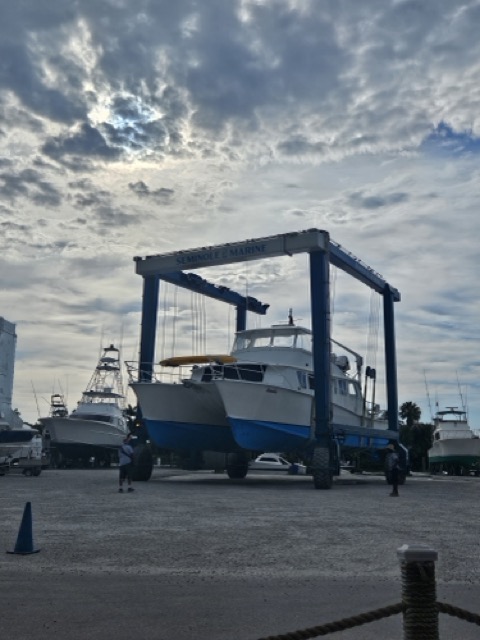
This year has continued to bring us unexpected curveballs this field season. Following our second trip, our research vessel Stenella needed a little T.L.C. in the yard before going back out to the Bahamas. After her week at the “boat spa”, she was ready to set sail again. Since our trip was shorter, we decided to concentrate our efforts on Little Bahama Bank (LBB). This area is our original study site from 1985. In 2013, a large number of our LBB dolphins migrated to Bimini due to a food crash. Learn more about the migration event here. Though we have a smaller population of dolphins on LBB now, we still prioritize spending time there to continue monitoring the resident population. This gave us a wonderful opportunity to exercise our efforts in this region.
It wasn’t long before we encountered bottlenose and spotted dolphins. On our first full day on LBB, we encountered Naia with her calf Nera. Naia was first seen as a calf in 1995 and has had several calves of her own over the years. Naia’s mother Zot was one of the immigrants to Bimini in 2013, but Naia stayed, illustrating how this significant event divided families. Now we see Naia continuing the family line through Nera and a new pregnancy. We hope to see them again this field season to monitor Naia’s pregnancy progression and may be welcoming a new member to the family next summer.
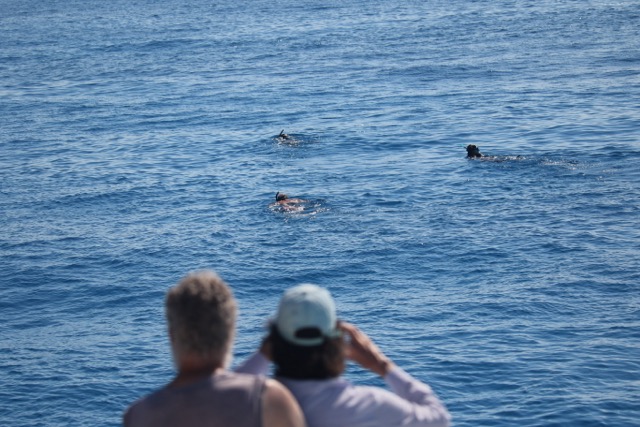
Passengers watch snorkelers during a dolphin encounter.
Later that day, we came across a group of ten bottlenose dolphins foraging further north. This group of adults and juveniles had a lot of scars, mutilations, and other distinguishable features which makes them easier to identify. One of the females we were able to identify was actually seen traveling and foraging alongside Naia and Nera just last season. Among this group was an individual with a lobomycosis infection. Lobomycosis is a chronic fungal disease that is transferred between individuals via direct contact. It is also zoonotic and can be transferred to humans. This is not something typically observed on Atlantic spotted dolphins, but it is not uncommon to see this on bottlenose dolphins.
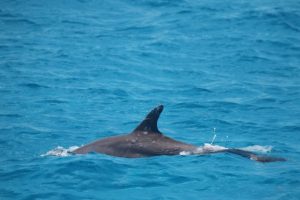
A bottlenose dolphin with lobomycosis visible on the dorsal fin. Photo by Allison Sanchez.
We ended our time on Little Bahama Bank with an Atlantic spotted dolphin encounter. This encounter included five males ranging from young juveniles to mature adults. The youngest member of the group, Arlo, was first seen on Little Bahama Bank last field season. After the 2013 food crash that destabilized the population there, it is not uncommon to encounter new migrants to the area. The newcomer was seen alongside long-time alliance Navel and Poindexter, who were both first seen as calves in 1986. The juxtaposition of the older males and the new juvenile demonstrates the changes this population has had to endure over the last four decades. The younger males were intensely curious about us and our vessel and were seen playing with seagrass. This final encounter was a wonderful way to end another successful trip in the Bahamas.
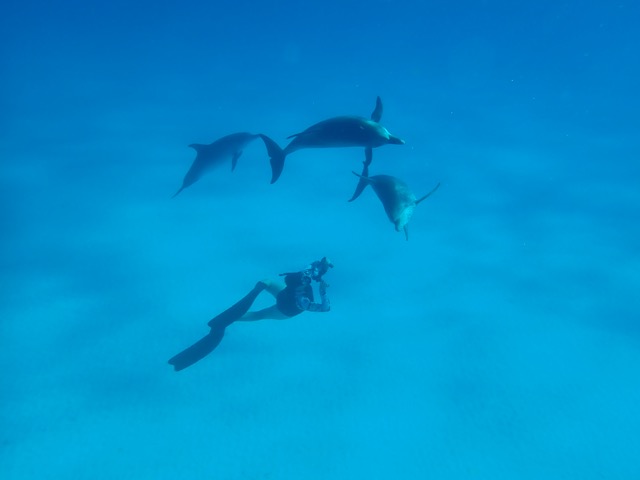
Field Assistant Allison documenting behavior from Arlo, Onyx, and Neon during an encounter. Photo by Alexandra Rose.