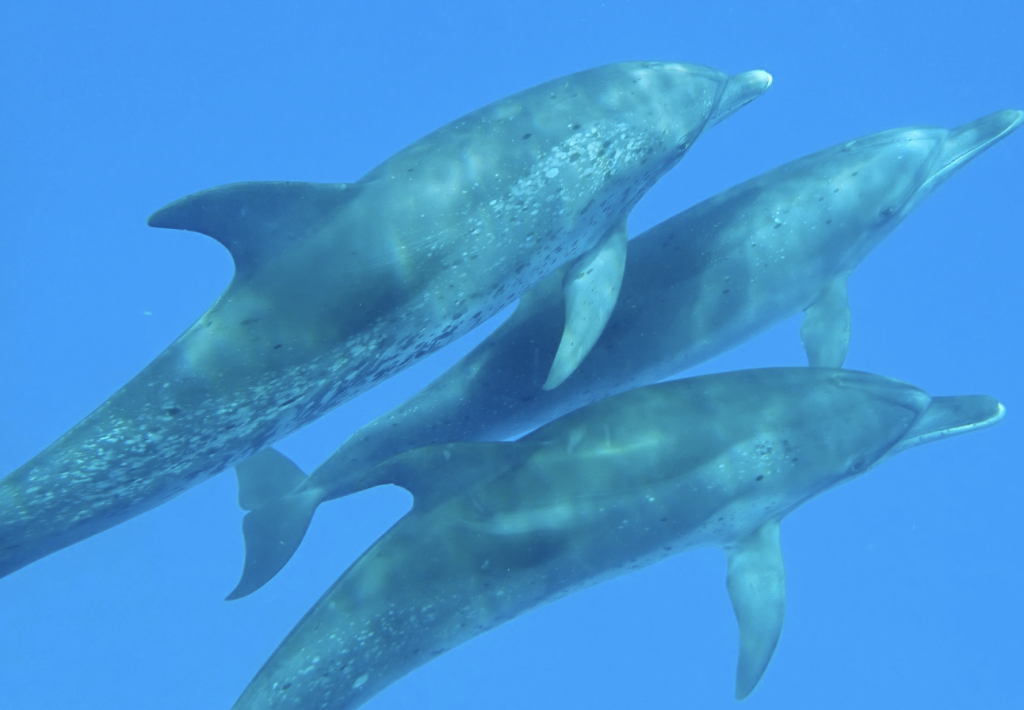
Our fifth trip of the season yielded several challenges that remind us how difficult field work can be. From unexpected weather to boat issues, Trip 5 packed a real punch. This is why preparation and safety are so important to any field project since you never know what you may encounter while in remote locations at sea. We are fortunate to have a strong and competent team capable of weathering any storm the Bahamas throws our way, both figuratively and literally!
Trip 5 was also a reminder of how sometimes the quality of the data collected can make up for limited time in the field. Despite the challenges, we had one wonderful interspecies encounter on Little Bahama Bank. A group of eight Atlantic spotted dolphins were observed interacting with a group of nine bottlenose dolphins. The group of spotted dolphins consisted of seven juvenile and young adult males and one juvenile female. The female, Nera, was last seen earlier in the summer swimming alongside her mother, Naia. As Naia was not present during this encounter and Nera is over three years old, it is possible Nera either weaned from Naia and is on her own or she was being babysat while Naia was away. We will have to keep an eye out for these two later in the season to get a better idea of the new dynamic.
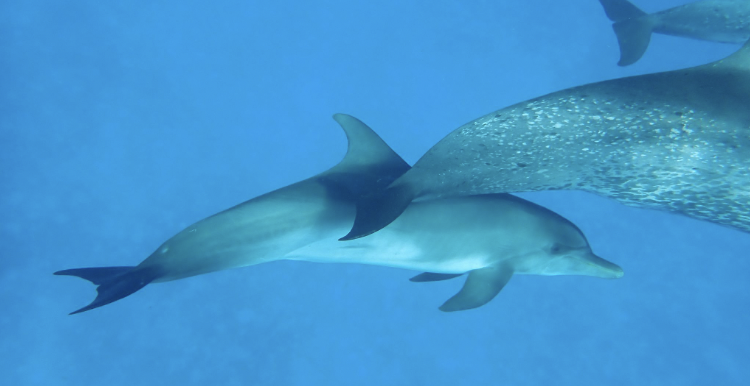
Nera swims behind young adult male, Venti.
Naia’s older brother, Nala, was also present during this encounter. Nala was first observed as a two-toned calf in 2017 and is now mottled, meaning his spots are coalescing and merging into each other. It was our first time seeing Nala this summer and he stayed near the other mottled males Venti, Bolder, and Neon. We observed head to head postures, biting, and chasing amongst the male spotted dolphins. Occasionally there was some tussling with the bottlenose dolphins, but multiple times they were seen traveling alongside one another without displays of aggression.
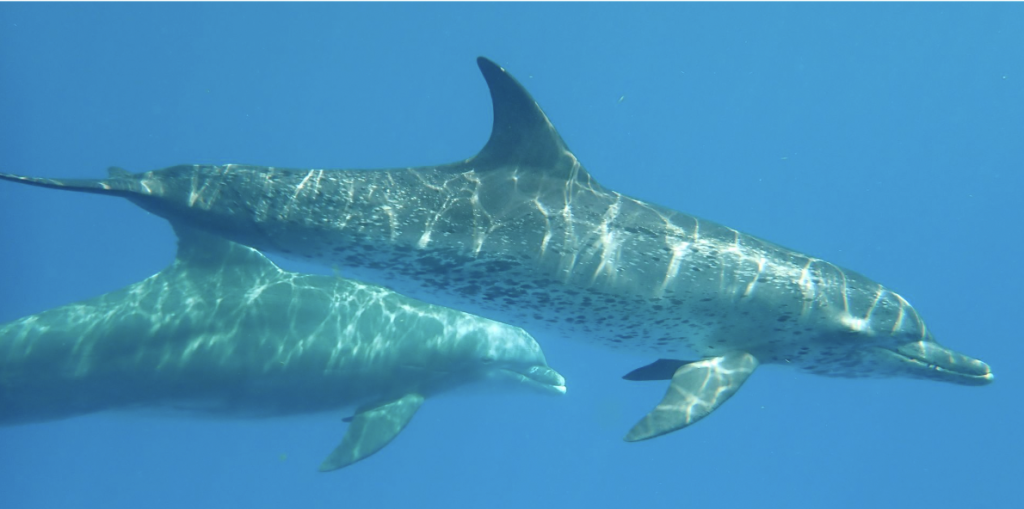
Nala swims alongside a bottlenose dolphin.
The group of nine bottlenose dolphins were very active. Both males and females were present within the group including a mom and calf pair. The males were courting the females and competing with one another. We observed lots of penis displays, chasing, and copulating.
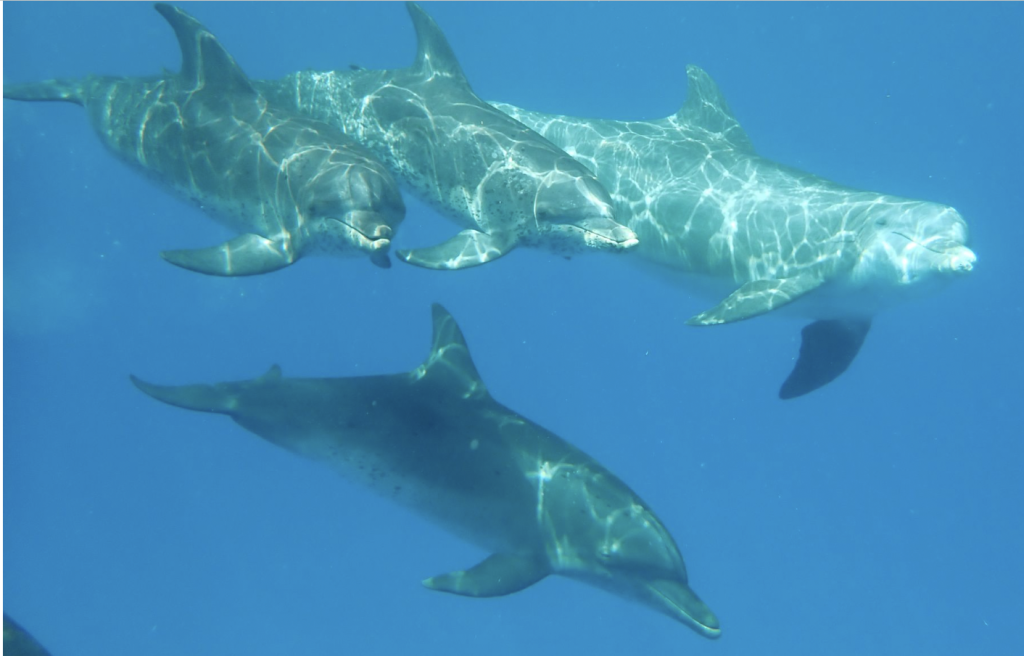
Atlantic spotted dolphins and bottlenose dolphin investigate camera.
The dolphins at the center of the trouble were none other than Pisces, Aussie, and Onyx. These young males are always seen traveling together and are likely the beginnings of a young alliance. Onyx was first observed in 2018 while Pisces and Aussie were not seen until 2024. Since then, the trio are seemingly inseparable. They are also a mischievous group and tend to be some of the more active dolphins on Little Bahama Bank, engaging in tussles with other males. In this encounter, they were particularly rambunctious while also being very interested in our camera equipment. They made numerous close passes buzzing at the camera. Buzzes are a form of echolocation that allows them to determine the shape, size, and texture of something. It is typical to hear echolocation buzzes and clicks when dolphins are investigating our gear.
Though the trip may not have been what we were expecting, we still gained valuable data that will help us better understand this small community. We are looking forward to more time on Little Bahama Bank in our upcoming final trip of the 43rd field season.