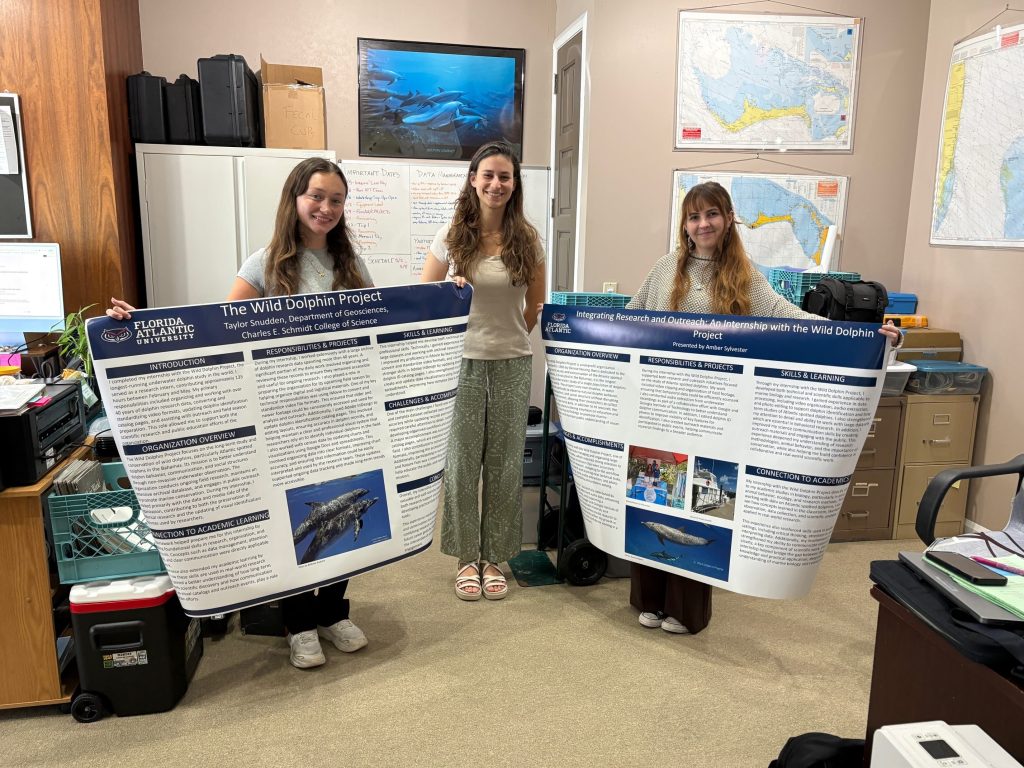
Intern Amber on the far right, presenting a poster of her internship at FAU.
As a biology student at Florida Atlantic University entering her fourth year, Amber has always been fascinated by the natural world. Growing up in several different places exposed her to a variety of ecosystems and sparked an early curiosity about how plants, animals, and environments interact. Her time living in Hawaii had a particularly lasting impact, inspiring a deep appreciation for the ocean and setting her on the path toward a career in marine science.
In this Q&A, she shares more about her journey, interests, and experience as an intern.
What made you want to apply to the Wild Dolphin Project specifically?
I was really drawn to the Wild Dolphin Project because of its long-term, non-invasive research approach. I think it’s incredibly important to study animals in a way that doesn’t disrupt their natural behavior, and WDP has such a strong reputation for that. I was also especially interested in the combination of outreach and research, since I value the role education plays in conservation. Being able to help communicate scientific findings to the public, while also contributing behind the scenes, felt like a great fit for me, especially since I also enjoy the creative aspect of creating outreach materials.
What were your expectations before arriving, and how did the experience compare?
I was prepared to learn a lot about field research, which I certainly have, but I didn’t realize just how detailed and in-depth the data work would be. It’s been really interesting to see how much information can be extracted from past video footage, and how each piece contributes to the bigger picture of the research. It’s given me a real appreciation for how important this behind-the-scenes work is in supporting long-term studies.
What does a typical day as an intern look like?
A typical day for me involves a mix of outreach preparation and research-based work. On the outreach side, I help create materials for events, such as handouts and displays, which are used to educate the public about our research efforts. On the research side, I work with footage from past field seasons, clipping and organizing videos based on behaviors, extracting audio, enhancing photo identification images, and working with 360 video content.
What has been your most memorable moment during your time here?
My most memorable experiences have been participating in outreach events and getting to speak with people who are genuinely interested in conservation and marine life. It’s been really meaningful to share what I’m working on and see how curious and engaged people are, especially when they learn more about dolphins and the research behind them.
What’s something new or surprising you’ve learned while working with the team?
I’ve been surprised by how much information can come from such detailed and careful work. Even small observations in video, audio, or photo data can contribute to a much larger understanding of dolphin behavior. I’ve also learned how important consistency and attention to detail are, because even subtle differences in how something is recorded or labeled can have a big impact later on in the data.
What has been the most challenging part of the internship?
The most challenging part has been learning how critical attention to detail is in this kind of work. Something as small as a mistyped encounter date can create much larger issues within a dataset. It’s taught me to slow down, stay focused, and really double-check my work, especially when handling long-term research data.
How has this experience changed the way you see dolphins or marine research?
It’s given me a much deeper appreciation for how much care and precision goes into ethical, long-term research. I’ve come to see dolphins not just as fascinating animals, but as individuals with complex behaviors and social relationships that take years of observation to truly understand.
What skills or lessons will you take with you moving forward?
I’ve gained a lot of technical and research skills, especially working with video and photo data. Beyond that, I’ve learned the importance of patience, consistency, and attention to detail. I’ve also developed some public speaking skills through outreach events, which has helped me become more confident in communicating science to different audiences. Overall, this experience has shown me how much collaboration and precision matter in both research and education.
What are your future goals, and how has this internship influenced them?
My future goal is to continue gaining both academic and hands-on experience in marine science. I plan to continue my education by pursuing a master’s degree to strengthen my academic background, while also gaining more field experience to develop my skills as a researcher. This internship has helped me better understand the different ways you can contribute to marine research and has reinforced my interest in being directly involved in fieldwork. I will also continue my work with WDP through the summer and join them for part of their field season, which I’m really looking forward to as an important next step.
How would you describe your time with the Wild Dolphin Project in one sentence?
A greatly meaningful experience that deepened my understanding of marine research efforts and strengthened my passion for the ocean and conservation work.