

Dolphins live in a world shaped by sound. In the ocean, where visibility can be limited, sound travels farther and faster than light. Dolphins have evolved highly sophisticated ways to produce, interpret and respond to acoustic signals—allowing them to coordinate behavior, maintain social bonds, find food and navigate their environment.
Decades of research shows that dolphin communication is complex, learned and context-dependent. WDP has a vast database of underwater sounds and behaviors, which have been collected over the past 40 plus years for the free-ranging community of dolphins we study in the Bahamas. Two initiatives are currently underway with a team at Georgia Institute of Technology. The first is to apply a variety of Machine Learning algorithms to discover patterns in the dolphins sounds, and possibly, if dolphins have language. The second is to utilize and underwater computer interface, CHAT, to explore two-way communication between the dolphins and researchers.

Dr. Denise Herzing with an early prototype of a CHAT box.
How Do Dolphins Communicate?
Dolphins communicate using a combination of sounds, body movements, and social behaviors, but sound is the foundation of their communication system. These vocalizations are produced in the nasal passages below the blowhole—not the mouth—and are received through specialized fatty tissues in the lower jaw.
Researchers generally categorize dolphin sounds into three main types: signature whistles, burst pulses, and echolocation clicks.
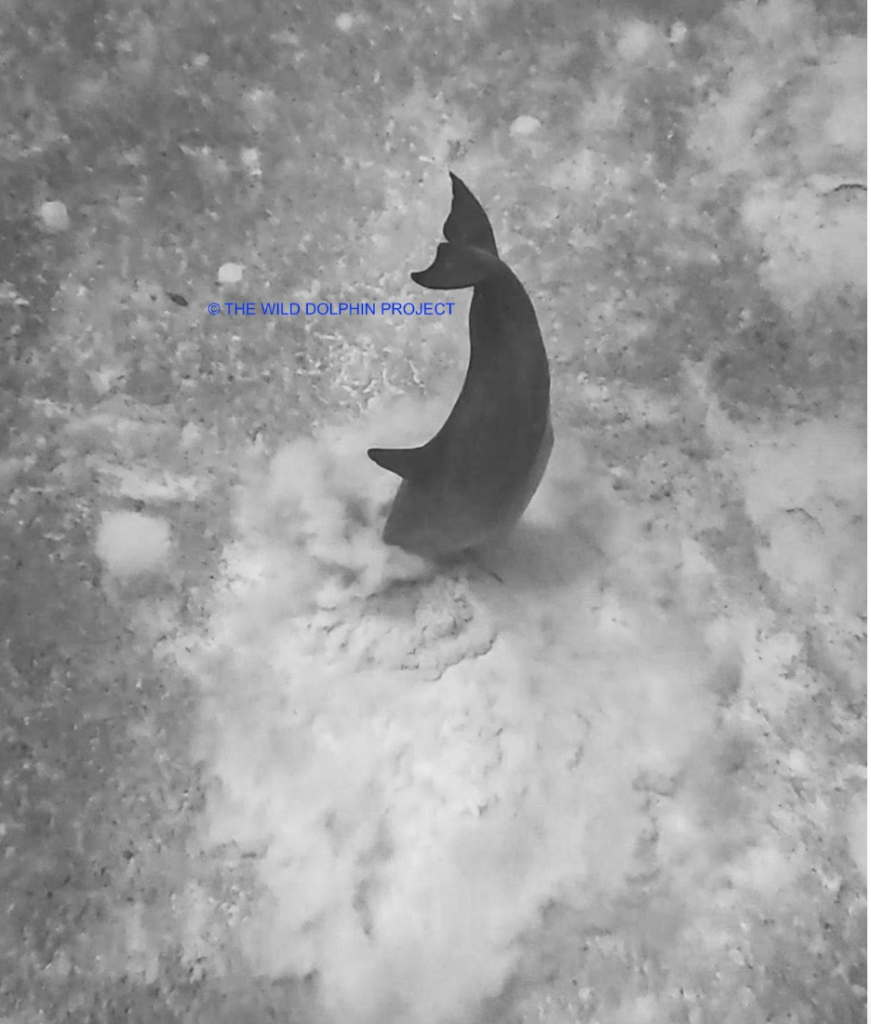
A dolphin digging in the sand to find fish, using their echolocation.
Signature Whistles: Individual Identity and Contact
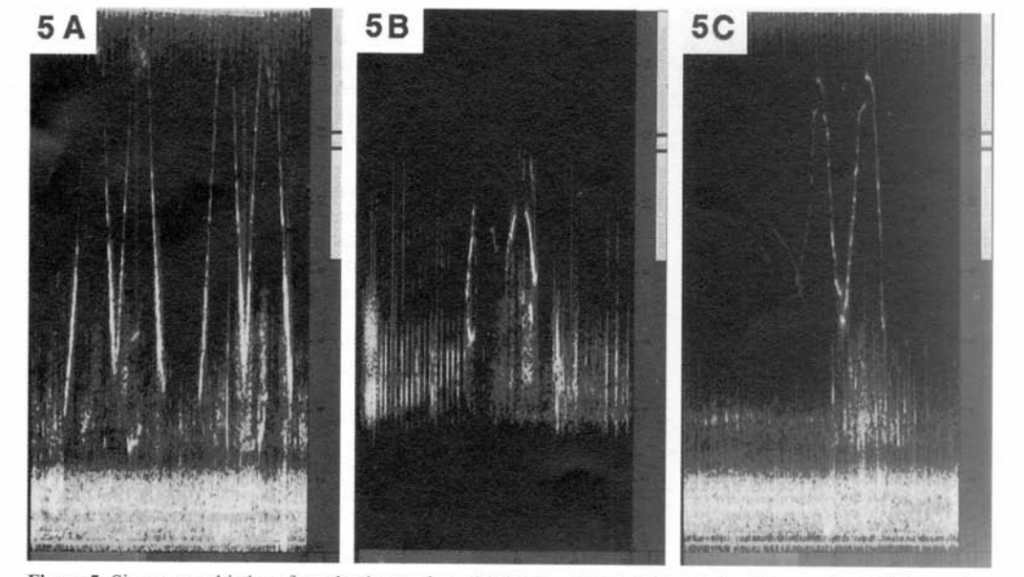
Signature whistle of a mom dolphin and her two calves, from Herzing 1996.
‘The spectrograms shown on the left are a visual representation
of sound in the time/frequency domain. Spectrograms are read left to right.
The vertical axis displays frequency in Hertz, the horizontal axis represents
time and amplitude is represented by brightness. The black background is
silence, while the bright orange curve is the sine wave moving up in pitch.
This allows us to view a range of frequencies (lowest at the bottom of the
display, highest at the top) and how loud events at different frequencies are. Loud events will appear bright and quiet events will appear dark.
One of the most remarkable discoveries in dolphin science is the existence of signature whistles. Each bottlenose dolphin develops a unique whistle early in life. This whistle functions much like a name, encoding the dolphin’s individual identity. Dolphins use signature whistles to:
-
Maintain contact with group members
-
Identify specific individuals
-
Reunite after separation
Research shows dolphins can recognize the signature whistles of close associates even after years apart, indicating long-term social memory. Mothers and calves, in particular, rely heavily on these whistles to stay connected. Signature whistles are learned rather than genetically fixed, highlighting the role of social learning and vocal development in dolphin societies.
Recent research shows that a dolphin’s signature whistle varies not just by individual but also by local environment and population context. For example, dolphins living over seagrass beds tend to use higher-pitched, shorter whistles than those in areas with muddy bottoms, suggesting that dolphins adapt their calls to the acoustic properties of their habitat and social group dynamics rather than genetics alone.
Burst Pulses: Social Signals and Emotional Context
Burst-pulse sounds are rapid sequences of clicks produced so closely together that they sound like buzzes, squawks, or creaks.
These sounds are commonly associated with:
-
Social interactions
-
Aggression or dominance displays
-
Courtship and mating behavior
-
High-arousal situations
Unlike signature whistles, burst pulses are highly context-dependent. The same dolphin may produce different burst-pulse sounds depending on social setting, emotional state, or behavioral intent. At WDP, researchers pair acoustic data with video observations to interpret what these sounds mean in real time.
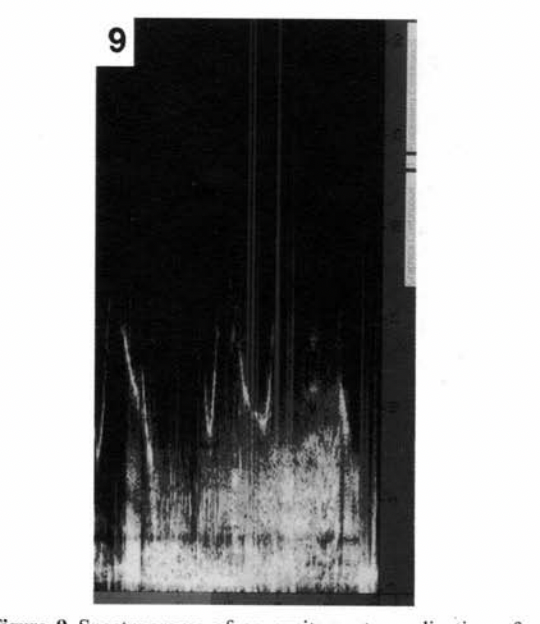
Spectrogram of a juvenile male producing an excitement vocal. Herzing 1996.
Echolocation: Seeing with Sound
Dolphins don’t just communicate with sound—they also use it to perceive their world through echolocation. By emitting high-frequency clicks and listening to returning echoes, dolphins can determine:
-
The size, shape, and distance of objects
-
The location of prey
-
Fine details such as texture and movement
To hunt and track prey, dolphins use their sonar, called echolocation. To humans, it sounds like clicks. The animal sends out a sound wave, which then bounces off an object, like a fish and returns to the dolphin. They receive the sound in their lower jaw, the signal moves to the middle ear and ultimately to the brain for interpretation. When the dolphins hunt at night, clicks are their primary sense because since vision is limited.
Dolphins also use clicks in social settings to tickle, or stimulate, another dolphin. Researchers have also documented a sound known as a “genital buzz.” This is a rapid series of low-frequency clicks produced when one dolphin closely approaches another’s genital area, most often during courtship or other sexual interactions. Rather than being used for navigation, these buzzes appear to play a role in social and reproductive communication, helping dolphins coordinate and interpret mating behavior.
Body Language
Sound is only part of the picture. Dolphins also communicate through:
-
Posture and orientation
-
Jaw claps and tail slaps
-
Synchronized swimming
-
Physical contact
These visual and tactile signals often reinforce acoustic messages, creating a multimodal communication system that is flexible and context-rich.

Aggressive encounter among males. Photo WDP.
Why Dolphin Communication Matters for Conservation
Understanding how dolphins communicate has direct conservation implications. Many human activities interfere with sound underwater, including:
-
Boat traffic
-
Coastal development
-
Seismic surveys
-
Military and industrial sonar
Noise pollution can mask dolphin vocalizations, disrupt social bonds, interfere with foraging, and separate mothers from calves. Protecting dolphin habitat therefore means protecting acoustic space, not just physical space.