
When people spend time watching wild dolphins, one thing becomes clear very quickly: these animals are not just swimming mammals — they are thinkers, communicators, and social beings with complex lives.
Decades of research by the Wild Dolphin Project (WDP), and other researchers, have helped scientists understand just how much dolphins have in common with us. From strong family bonds to learning, communication, and even individual personalities, dolphins share surprising similarities with humans.

Dr. Denise Herzing has studied the same community of Atlantic spotted dolphins since 1985.
Dolphins Live in Strong Social Communities
Like people, dolphins are highly social animals. They live in groups called pods, often made up of family members and long-term companions in what’s called a fission-fusion society.
A fission–fusion society is one where group members don’t stay together all the time. Dolphins form groups that come together (fusion) and split apart (fission) depending on things like food, safety, travel, social bonds, and life stage. Individuals may spend time with different companions throughout the day, then reunite later.
This flexible social system allows dolphins to maintain strong relationships — much like how people move between family, friends, school, and work groups.
Female dolphins, for instance, tend to spend time with others in similar life stages — mothers often associate with other mothers, pregnant females with pregnant females, and young adults with other young adults. These social groups provide support, learning opportunities, and safety.
Mother dolphins form deep bonds with their calves, caring for them for several years. Calves learn essential life skills — how to find food, avoid danger, and communicate — by watching and interacting with their mothers and other dolphins in the group. Older sisters, aunts, and related females without calves often spend time nearby, helping to “babysit” and giving younger dolphins a chance to learn parenting skills before they have calves of their own.
Just as human children learn by observing adults, young dolphins learn through imitation and practice.
Male dolphins form strong social bonds as well, often developing close partnerships that can last a lifetime. These long-term alliances — similar to best friends — help males cooperate during conflicts with other males and improve their chances of finding mates.
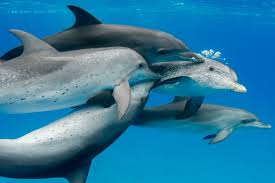
A young male group courting a female, named Mila.
Dolphins Have Individual Names — Just Like People
Each dolphin develops a unique sound called a signature whistle, which functions in some ways like a human name. Dolphins use these whistles to identify themselves and to recognize one another within their social groups.
Through decades of research, scientists with WDP have recorded signature whistles from known individual dolphins while observing dolphins underwater with video cameras and recording sounds with hydrophones (underwater microphones).
Recent research has revealed something especially fascinating: mother dolphins change the way they whistle when their calves are nearby. Much like human parents use a higher-pitched, exaggerated form of speech often called “motherese” (think Ms. Rachel) when talking to babies, dolphin mothers modify their signature whistles in the presence of their young.
Dolphins Communicate Constantly
People rely on language, facial expressions, and gestures to communicate. Dolphins do the same — just underwater. Dolphins communicate using:
-
Whistles
High-pitched sounds used for communication, including identifying individuals and staying in contact with others.Clicks
Short, sharp sounds used for echolocation, helping dolphins “see” their environment and locate prey underwater.Burst-pulses
Rapid series of clicks used during close social interactions, often linked to excitement, play, or conflict.Body postures
Movements like head lifts, jaw displays, or body positioning that send clear social signals.Touch and movement
Physical contact such as pectoral fin rubbing, chasing, or synchronized swimming used for bonding, coordination, and communication.
These sounds and behaviors are used during play, social bonding, coordination, and even conflict. For example, dolphins may show aggression by opening their mouths or, in more intense situations, through physical behaviors such as charging, biting, tail slaps, and raking.
During friendly interactions and reunions, dolphins often rub pectoral fins — a behavior associated with bonding and reassurance. Mothers also discipline their calves when needed, especially if a calf becomes too rowdy or drifts too far, helping keep them close and safe.

A bubble ring (torus) is a strong signal in dolphins — often meaning aggression or “back off,” especially during dominance or conflict.
Dolphins Learn, Teach, and Pass Down Knowledge
One of the strongest similarities between dolphins and humans is culture — behaviors that are learned and passed from one generation to the next.
In parts of southern Brazil, bottlenose dolphins and local fishers have developed a cooperative fishing tradition that has lasted for generations. The dolphins herd schools of mullet toward the shoreline and signal fishermen — often with tail or head slaps — when to cast their nets. This partnership, practiced by only some dolphins in the population, appears to be socially learned and passed down through dolphin communities, as helper dolphins tend to stick together and spend time with other dolphins that use the same technique. Scientists consider this interspecies fishing alliance a form of dolphin culture, because it is a behavior that is learned, shared, and maintained within a specific group over time rather than being instinctive
This kind of learning mirrors how humans pass down skills, traditions, and knowledge.
Dolphins Show Emotions and Personalities
Anyone who has spent time observing dolphins can tell you that no two dolphins are exactly alike — and we see this clearly in the Bahamas.
Some dolphins are bold, curious, and playful, while others are cautious and standoffish. Certain individuals enjoy playful interactions, like games of seaweed keep-away with people in the water, while others prefer to keep their distance. Dolphins display behaviors that suggest excitement, curiosity, frustration, and affection — emotional states that feel very familiar to us.
During our field seasons, we’ve even identified dolphins known as “camera-hogs” — individuals who seem to enjoy swimming directly in front of underwater cameras. Perhaps they’re curious about their reflection in the large camera domes. At other times, we’ve watched dolphins find objects in the ocean and turn them into toys. One memorable moment involved a dolphin named Sunami, who picked up a flip-flop and balanced it on his head.
Another young male, aptly named Brat, seemed to delight in causing trouble. He was often seen carrying pieces of coral or sea cucumbers and pestering filefish by directing his echolocation at them.
Researchers have also documented dolphins forming preferred friendships, cooperating with certain individuals, and avoiding others — much like people navigating complex social relationships.
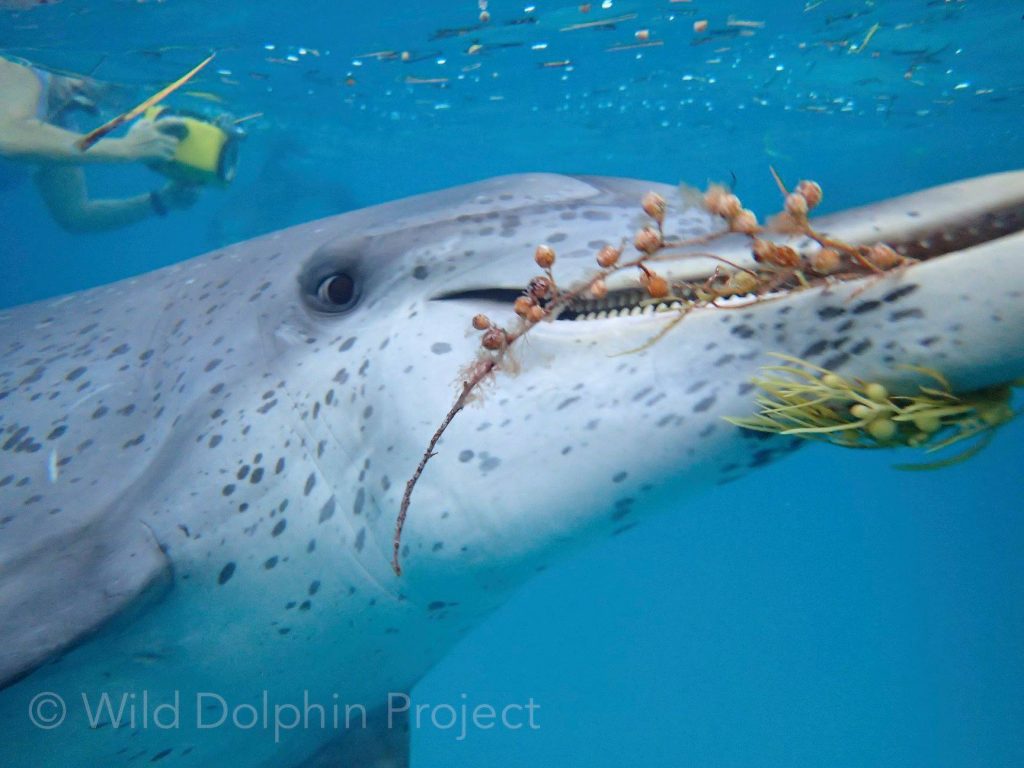
Dolphins Use Tools — A Rare Human-Like Trait
Tool use is often considered a sign of advanced intelligence, and dolphins are one of the few non-human animals known to use tools.
In some dolphin populations, individuals use marine sponges to protect their snouts while foraging along the seafloor. This behavior is learned, not instinctive, and passed from mother to calf — another example of dolphin culture.
Dolphins also use their environment in creative ways while hunting. In the Bahamas, bottlenose dolphins practice crater-feeding, digging into sandy bottoms to flush out hidden fish. In other regions, dolphins have been observed creating mud rings, circling fish with clouds of mud to trap them before feeding. These complex strategies require coordination, learning, and precise timing.
Recent researched described orcas (the largest dolphin species) using kelp. In some populations, orcas have been observed draping strands of kelp over their bodies and rubbing against one another — a behavior scientists believe may help with skin care, parasite removal, or social bonding. This behavior appears to be learned and socially shared, rather than instinctive.
Orcas are also masters at using their environment as a tool while hunting. Different populations have developed specialized techniques passed down through generations. For example:
-
Some orcas work together to create waves that wash seals off ice floes.
-
Others herd fish into tight balls, making them easier to capture.
-
In shallow waters, certain orcas intentionally strand themselves briefly on beaches to grab prey, then wriggle back into the water — a risky technique taught from adults to young. Bottlenose dolphins also do this along the southern East Coast of the U.S.
Why These Similarities Matter
Understanding how dolphins are similar to people changes how we think about our responsibility toward them.
Dolphins are not just wildlife we observe — they are sentient beings with relationships, memories, and culture. Protecting dolphins means protecting:
- Individuals
-
Their families
-
Their habitats
-
Their ability to communicate and pass on knowledge
The Wild Dolphin Project’s non-invasive research approach — observing dolphins in their natural environment without feeding or training them — allows scientists to study dolphin behavior ethically while respecting their autonomy.
Learn More
To explore ongoing dolphin research and discoveries, visit the Wild Dolphin Project, where scientists have been studying the same wild dolphin families for decades — revealing one of the richest understandings of dolphin behavior anywhere in the world.