
When people imagine diverse and thriving marine ecosystems, they often picture colorful coral reefs. Yet one of the most essential essential habitats on Earth is often overlooked: seagrass meadows. These underwater flowering plants (yes, they flower!) form vast, green landscapes that sustain marine biodiversity providing shelter for crabs, fish, and shellfish, stabilize coastlines, and even regulate the global climate. And for us at the Wild Dolphin Project, it is habitat and home for the dolphins we study.
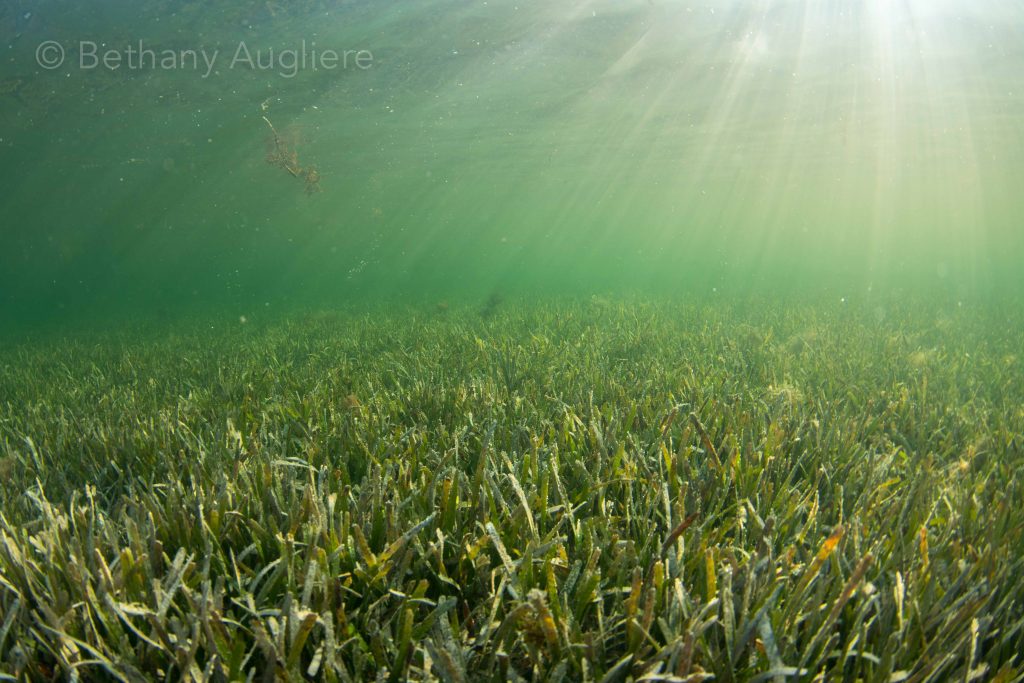
What Is Seagrass?
Seagrasses are not seaweeds, but true flowering plants adapted to life underwater. They grow in shallow, sunlit coastal waters around the world, forming dense meadows rooted in sandy or muddy seabeds. Like terrestrial plants, they photosynthesize, producing oxygen.
Globally, there are at least 60 species of seagrass, and in regions like Florida and the Bahamas, species such as turtle grass and manatee grass dominate coastal ecosystems. These meadows can stretch for miles, creating continuous habitats that support an extraordinary range of marine life. In Florida for instance, there are 2.2 million acres of seagrass.
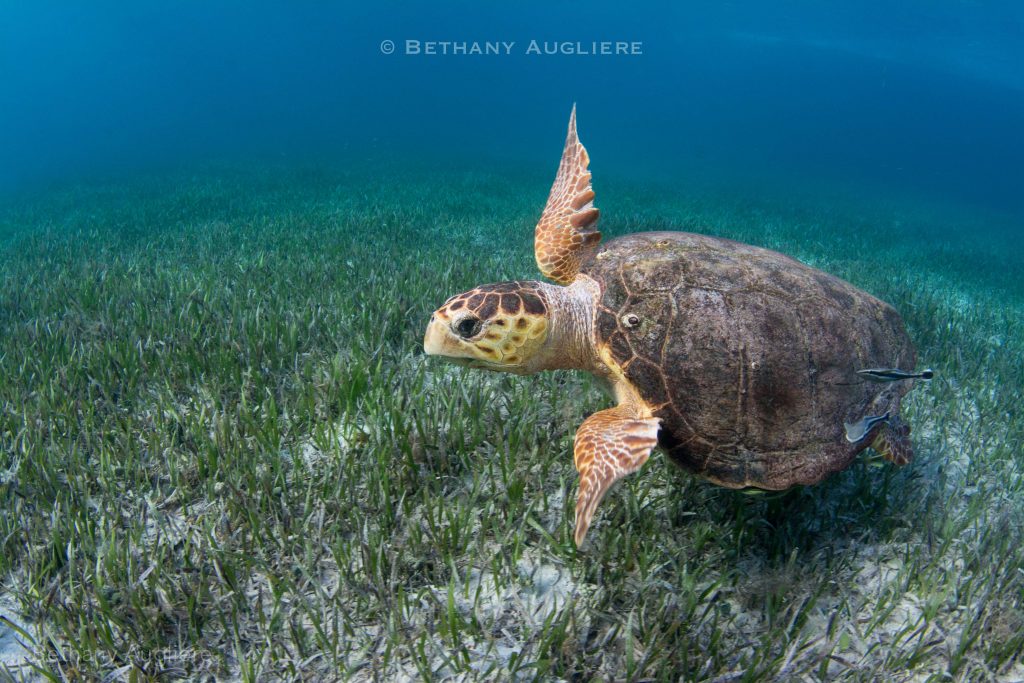
Loggerhead cruising over seagrass at our field site in the Bahamas.
A Biodiversity Powerhouse
Seagrass meadows provide food, shelter, and nursery grounds for thousands of species—from tiny invertebrates to large marine mammals. Juvenile fish, including many commercially important species, depend on seagrass for protection during their early life stages. Crustaceans like shrimp and crabs, mollusks, and even seahorses all rely on these habitats.
For herbivores such as green sea turtles and manatees, seagrass is a primary food source. But even species that don’t eat seagrass directly—like dolphins—depend heavily on the life it supports.
In the shallow, seagrass-rich waters of Florida Bay, bottlenose dolphins are known to use an extraordinary hunting technique called mud ring feeding. In this coordinated behavior, one dolphin swims in tight circles along the seafloor, using its tail to stir up a plume of sediment that forms a ring around a school of fish. Trapped and disoriented, the fish attempt to escape by leaping out of the water—only to be caught by other dolphins waiting strategically around the ring.
In parts of Shark Bay, Australia, bottlenose dolphins have developed a unique foraging strategy known as “sponging,” which is closely tied to seagrass habitats. These dolphins carry marine sponges on their rostrums (beaks) to protect themselves while probing the seafloor for hidden prey buried within sandy, seagrass-covered areas.
In the Bahamas, we also see dolphins use seagrass as a toy, just like they do with sargassum!
Seagrass Importance
Seagrasses do far more than provide habitat—they actively shape their environment. Their root systems stabilize sediments, reducing erosion and protecting coastlines from storms.
Their leaves slow water movement, allowing suspended particles to settle. This process improves water clarity, which is essential for both seagrass survival and nearby ecosystems like coral reefs.
Seagrasses also act as natural filters, absorbing excess nutrients and pollutants from runoff before they can damage marine ecosystems. This filtration helps prevent harmful algal blooms and supports overall ocean health.
Importantly, seagrass meadows are deeply interconnected with mangroves and coral reefs. Together, these habitats form coastal ecosystems that support each other biologically and physically.
One of the most remarkable—and often overlooked—roles of seagrass is its ability to combat climate change. Seagrass meadows are highly efficient at capturing and storing carbon, a function known as “blue carbon” sequestration.They account for more than 10% of the carbon stored in marine sediments annually. Seagrass can capture and bury carbon up to 35 times faster than tropical rainforests, locking it away in their roots and surrounding sediments for centuries.
A Delicate and Threatened Habitat
Despite their importance, seagrass ecosystems are under threat worldwide. Coastal development, pollution, dredging, and climate change are causing widespread declines.
Nutrient runoff from land can cloud the water, blocking sunlight that seagrass needs to survive and also leading to harmful algal blooms. Physical damage from boat propellers and anchors can scar seagrass beds, sometimes taking years or decades to recover.
The loss of seagrass has cascading effects. Without it, fish populations decline, water quality worsens, and species like dolphins lose critical foraging habitat. In Florida, for instance, more than 90% of the seagrass biomass was lost within the Indian River Lagoon. And manatees went through a period of starvation due to lack of quality seagrass. From December 2020 through April 2022, 1,255 manatees died.
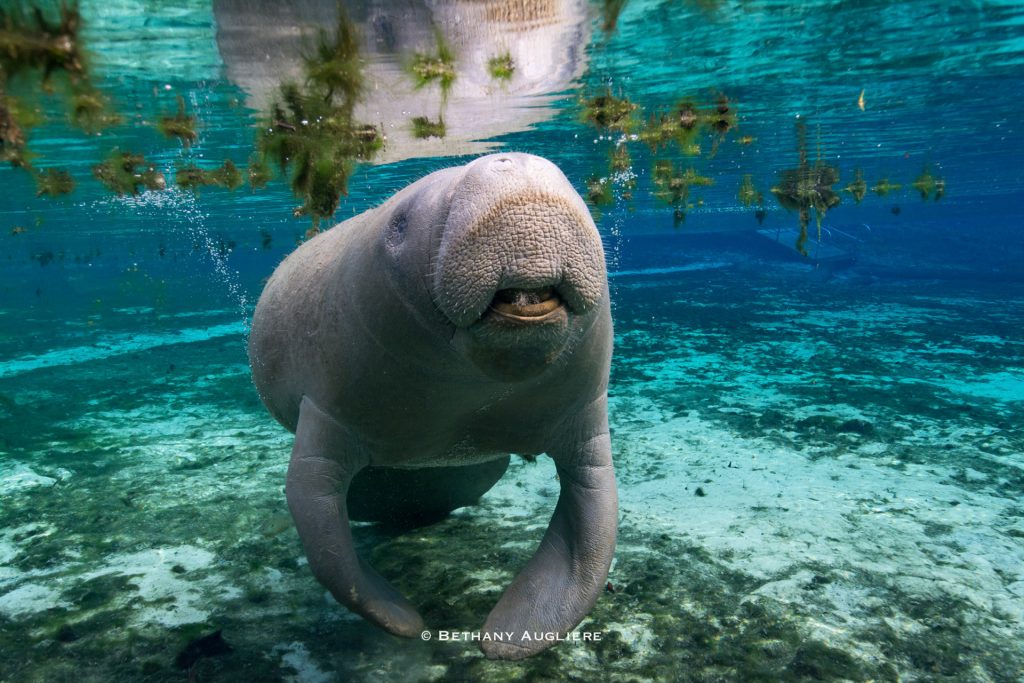
Manatee in a freshwater spring.
The bottom line: we ALL need seagrass from humans to manatees to snappers. So, if you didn’t appreciate seagrass before, we hope you do now!