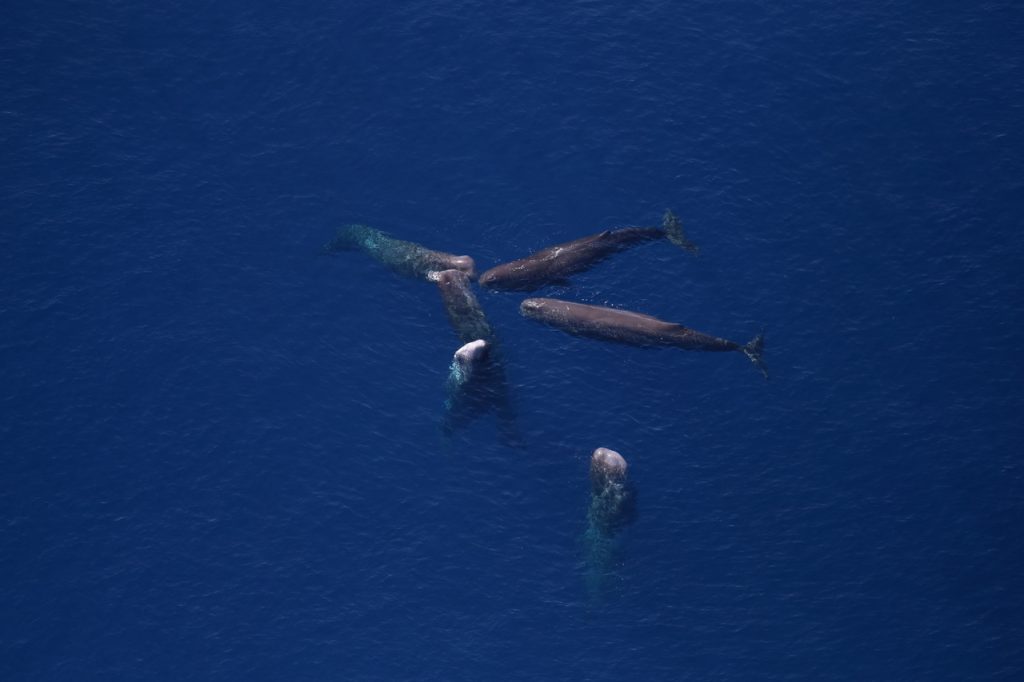
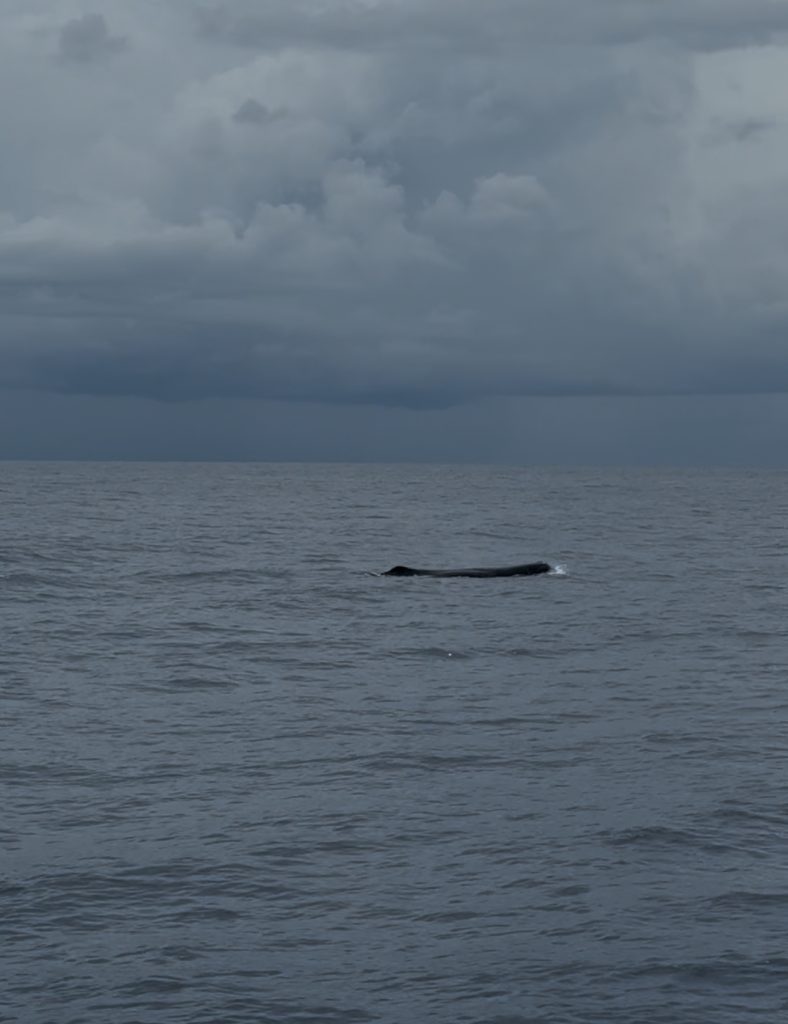
Sperm whale seen by Wild Dolphin Project in 2025.
In March, Dr. Shane Gero will be joining us at our 8th annual Wild Ocean Science event and sperm whales will be the topic of conservation! So, read on to learn a little bit more about Dr. Gero and sperm whales.
In 2005, Dr. Gero founded the Dominica Sperm Whale Project, an innovative and integrative long-term behavioral study of sperm whales in the Eastern Caribbean. He documents the social and vocal behavior of over 20 sperm whale units. Through thousands of hours of observation, he has come to know the whales as different individuals, as brothers and sisters, as mothers and babysitters, and as a community of families, each with their own way of doing things, living together in the Caribbean Sea.
Dr. Gero is also the Biology Lead for Project CETI, a non-profit organization and TED Audacious Project applying advanced machine learning and gentle robotics to decipher sperm whale communication. He has talked for National Geographic and TEDx stages and his writing has appeared in the New York Times; and most recently in James Cameron’s Emmy award winning Secrets of the Whales from Disney and National Geographic.
|
Photos by Amanda Cotton |
What Are Sperm Whales?
Sperm whales (Physeter macrocephalus) are the largest toothed whales on Earth and among the deepest-diving mammals ever recorded. Adult males can reach lengths of over 50 feet and dive more than 2,000 meters (6,500 feet) in pursuit of squid.
They are named after the waxy substance—spermaceti—found in their heads. The spermaceti is an oil sac that helps the whales focus sound.
They live in deep oceans all over the world, from warm waters near the equator to the icy seas near the North and South Poles.
Deep-Sea Divers and Apex Predators
As apex predators, sperm whales help regulate mid-water ecosystems. Their dives can last up to 2 hours during which they use powerful echolocation clicks to locate prey in near-total darkness. These clicks are among the loudest biological sounds in the ocean, functioning as both a hunting tool and a communication system.
Complex Social Lives and Culture
Female sperm whales live in stable matrilineal groups, forming long-term bonds and cooperative care systems for calves. These groups communicate using patterned click sequences known as “codas,” which differ between clans—suggesting distinct cultural identities. This is a central focus of Project CETI, which applies advanced machine learning and bioacoustics to better understand sperm whale communication.
Population Status
Commercial whaling from the 1800s through the 1980s dramatically reduced sperm whale populations worldwide. After the International Whaling Commission enacted a ban on commercial whaling in 1986, hunting pressure declined significantly. The species is still recovering, and in some regions, numbers appear to be slowly increasing. However, threats still exist.