
Listening to Leviathan: What we can learn from the whales’ way of life
At this year’s Wild Ocean Science Event, we were honored to welcome Dr. Shane Gero, Founder of the Dominica Sperm Whale Project,Biology Lead for Project CETI (Cetacean Translation Initiative), Scientist-In-Residence at Canada’s Carleton University, and a National Geographic Explorer. A marine biologist who has spent over two decades studying the same families of sperm whales off the coast of Dominica, Dr. Gero is at the heart of one of the most ambitious scientific efforts of our time: using artificial intelligence to listen to whales—and begin to understand what they’re saying.
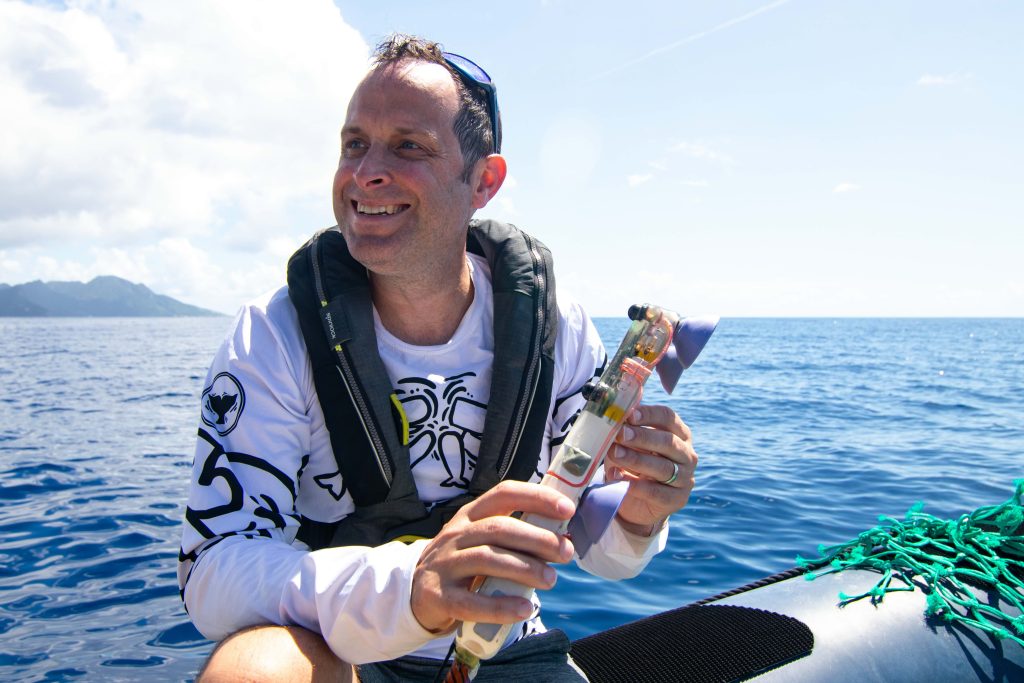
Dr. Shane Gero with CETI Custom Whale Tag. Credit: Michael Lees, National Geographic Society
Project CETI is a groundbreaking nonprofit applying advanced machine learning and cutting-edge ocean technology to decode sperm whale communication.
From Whale Songs to Translation
In the late 1960s, the world first truly heard whales. Recordings by the late Dr. Roger Payne—whose work helped spark the global “Save the Whales” movement—revealed that humpback whales sing complex songs to one another. Those sounds helped fuel public empathy, major conservation wins, and ultimately the Marine Mammal Protection Act.
Project CETI builds directly on that legacy, asking the next, tantalizing question:
What if we could understand what whales are saying—not just hear them?
Project CETI (is a nonprofit organization registered in the United States and Dominica and a National Geographic Society Program that is applying advanced machine learning and state-of-the-art robotics to listen to and decode the communication of sperm whales.
Founded in 2020 as a TED Audacious Project, CETI brings together more than 50 scientists across seven disciplines—from marine biology and linguistics to artificial intelligence, cryptography, and robotics—to tackle the mystery of whale communication.
Why Sperm Whales?
CETI focuses on sperm whales, and for good reason. Using decades of ongoing research by Shane Gero and The Dominica Sperm Whale Project, CETI has been able unlock that these whales share remarkable similarities with humans:
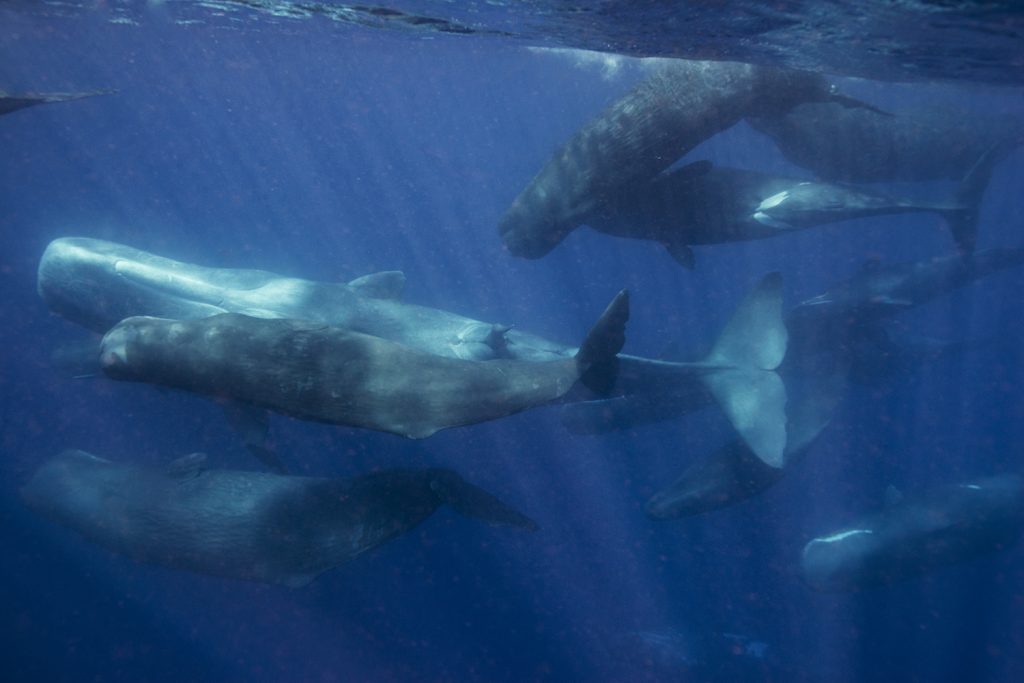
- They live in multigenerational matrilineal societies
- They have distinct dialects and cultural groups
- They possess the largest brains of any animal on Earth
- They show evidence of complex thought, social learning, and long-term bonds
Their codas have a structured, Morse-code–like quality, making them an ideal candidate for language analysis using modern machine learning tools.
While scientists have made progress in recent years, our understanding of sperm whale communication is still in its infancy. Only in the last twenty-five years have we begun to learn how some of their vocalizations are used for communication. CETI aims to change that.
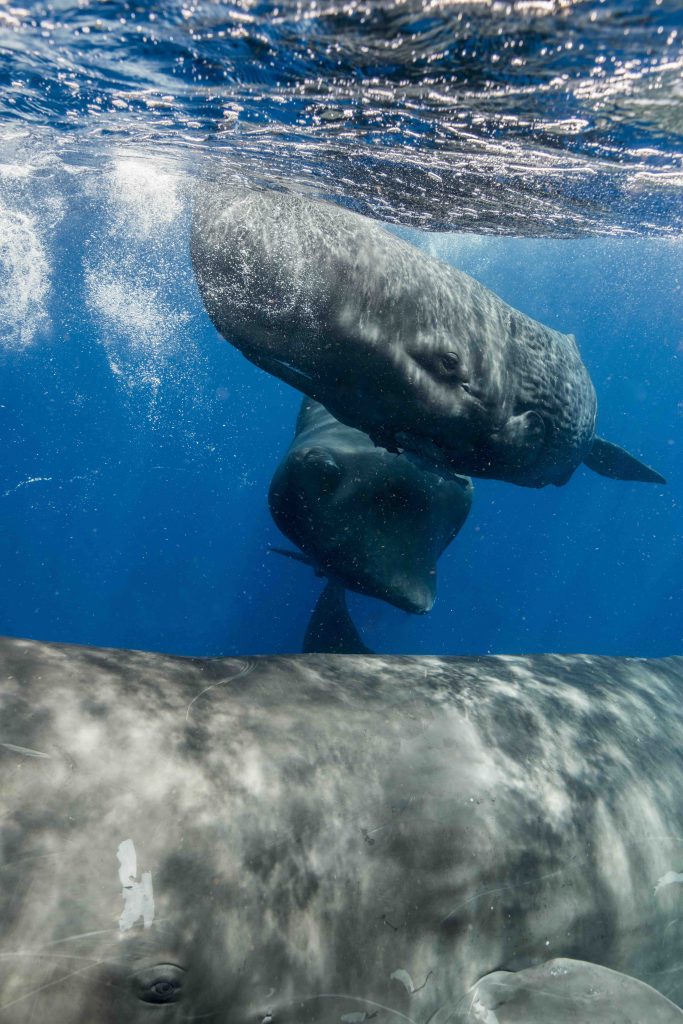
Photo Credit: Amanda Cotton
What Project CETI Is Doing in the Ocean
CETI’s research is centered off the coast of Dominica, home to a community of sperm whales and a long-standing community of whale researchers.
Their work includes:
- Deploying non-invasive hydrophone arrays and underwater robotic gliders to listen to whales in their natural environment
- Using bio-inspired, gentle whale tags to better understand social context and behavior
- Building massive, open-source datasets of whale sounds
- Applying advanced AI and natural language processing to detect patterns, structure, and meaning
- Publishing peer-reviewed research, including a scientific roadmap in iScience
- Collaborating with National Geographic Society to share discoveries through global storytelling and education
All of this is done with a strong emphasis on minimizing disturbance and prioritizing animal welfare.
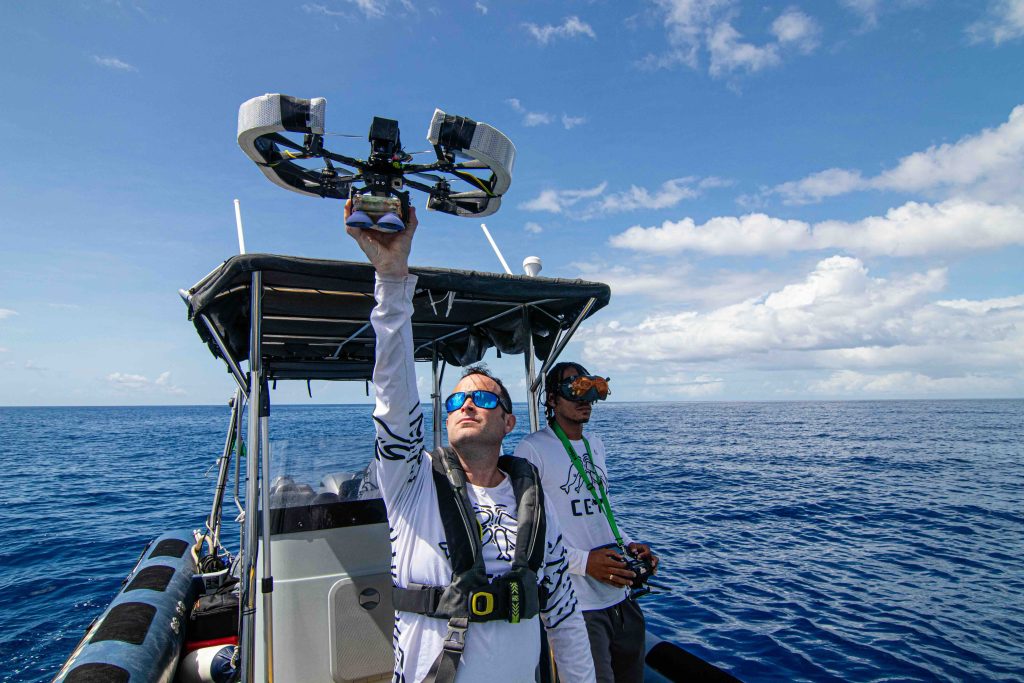
Dr. Shane Gero with Zahrek Gonzalez-Peltier on CETI Boat in Dominica. Credit: Michael Lees, National Geographic Society
Science That Supports Local Communities
A core value of CETI is that cutting-edge science should also support the people who live alongside these animals.
In Dominica, CETI has launched the Dominica Marine Conservation Fellowship, a 10-month training program for young Dominicans interested in marine science. Fellows receive hands-on experience in research, fieldwork, storytelling, and leadership—helping build long-term, locally led conservation capacity.
.
Ethics at the Center of Discovery
Understanding animal communication raises profound ethical questions—and CETI is confronting them head-on.
The organization works closely with the More-Than-Human Life Project at NYU School of Law to help develop ethical and legal frameworks for interspecies communication. CETI is also deeply concerned with the impacts of human-caused ocean noise, studying how sound pollution affects whale behavior and stress.
Importantly, CETI is committed to being gentle, cautious, and transparent. Current research focuses on listening and translation—not playback experiments—and their robotics are designed to be among the least invasive tools ever used in marine research.
Why This Matters
If successful, Project CETI could:
- Transform our understanding of animal communication
- Open new doors in marine biology and conservation science
- Strengthen policy protections for whales and ocean habitats
- Shift how humans see their relationship with other intelligent life on Earth
At its heart, CETI is about perspective—about listening more carefully, expanding empathy beyond our own species, and recognizing that the ocean is full of voices we are only beginning to hear.
Credit: Amanda Cotton
Learn More & Get Involved
To learn more about Project CETI, explore their research, or follow their journey, visit projectceti.org. You can also find them on Instagram, LinkedIn, and Bluesky.
We’re grateful to Project CETI for sharing their work with the Wild Dolphin Project community—and for reminding us that conservation often begins with listening.